
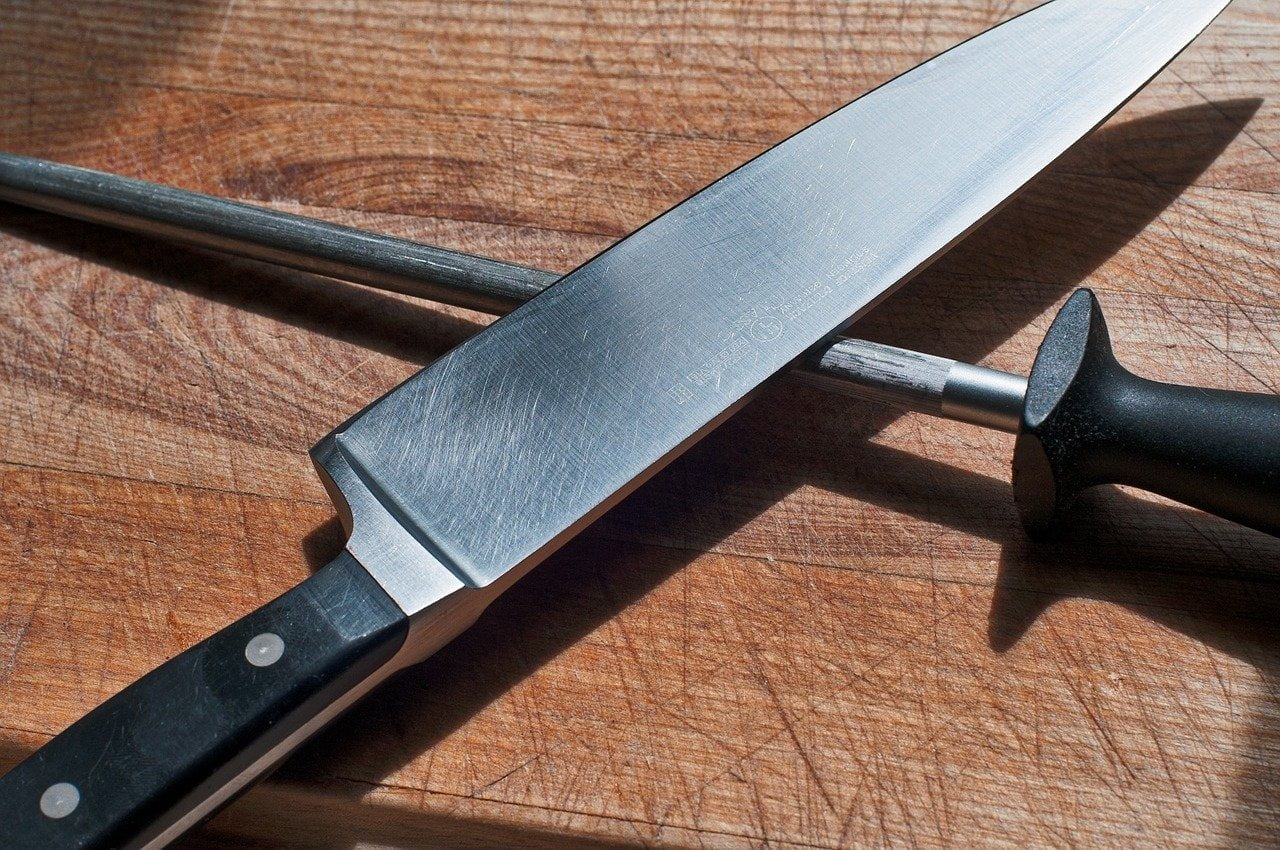
No matter how sharp a kitchen knife you choose for your kitchen, the time will come to polish its blade. Dull blades are a completely normal phenomenon and apply even to the best quality knives, so you should always have a properly selected sharpener on hand. The task of such a gadget is to restore the knife’s blade to the same sharpness as on the day of purchase. However, for this to be possible, you need to know which sharpener to reach for. Sharpening kitchen knives can be quick and easy. So what are our options?
Types of knife sharpeners – division by type of sharpening surface
The choice of knife sharpeners is quite large, so at first, you may have trouble choosing the perfect model. One of the divisions of knife sharpeners is related to the material from which the product is made. We distinguish:
- stone sharpeners,
- ceramic sharpeners,
- diamond sharpeners,
- steel sharpeners,
- tungsten carbide sharpeners.
The rule for choosing the type of cutting surface is simple: the material must be harder than the one from which the knife’s blade is made. Let’s also remember that a knife should be sharpened regularly.
Types of knife sharpeners – division by form, which knife sharpener?
How to sharpen a knife? Sharpeners for sharpening knives can also be divided due to their form (shape) and method of use. In this division, the differentiation is even more extensive, because we can choose from:
- rod-type sharpeners – built from a comfortable handle and a rod, suitable for sharpening long knives, at any angle,
- compact sharpeners – have a folding form, which is why they work well for transport and take up little space, they usually grind the steel at a 17° angle, which is worth keeping in mind when buying them,
- dog bone-type sharpeners – they look like a bone: they consist of a rod protected on both sides with rubber pads, they can be used at any angle,
- stone block – this is a type of sharpener made of natural or synthetic stone with various grits, the block (as the name suggests) has the form of a cuboid, it is best to use it wet to facilitate friction and reduce the wear of the sharpener itself,
- V-type sharpeners – they are built from a flat base and two rods, arranged in a letter “v”, their use is so convenient that you just need to guide the blade perpendicularly to the base, and it will be perfectly sharpened, there is no need to keep track of the grinding angle,
- electric sharpeners – these are devices powered by electricity that sharpen the knife’s blade on their own at a selected angle, they only require the user to move the blade along a designated line,
- sharpening systems – that is, sets built from a guide and sharpeners with various grits, suitable for owners of different knives.
Read also: Shapton Kuromaku and Glass HR Ceramic Stones
How to choose the best knife sharpener?
Before you choose a knife sharpener, check what material will be suitable for polishing the given blades. The most popular steel knives can be sharpened with practically any sharpener. Meanwhile, for Japanese knives and Damascus steel knives, you will need a wet sharpener, for example, a stone. If you have ceramic knives, choose a diamond sharpener. For knives with a serrated blade, you need a rod-shaped sharpener. Its diameter must be matched to the size of the knife’s serrations, so that the honing steel allows for a precise grind of each of them.
Don’t skimp on buying a sharpener, because a poor-quality product won’t last very long. It’s always worth checking how the sharpener’s handle is mounted in the case of rod-type models, while when choosing sharpeners in the form of a stone, it’s good to opt for a variant with an additional mounting base. A beneficial purchase will also be a stone with different grits on the sharpening surfaces. For home use, models with a grit of 1000 – 3500 are useful. Investing in such a sharpener is a universal choice, because on a stone you can often also sharpen kitchen scissors or cleavers. A sharp knife is most important right after the cook.
The length of the sharpener can also be important. The working part of such a gadget should always be 2 – 5 cm longer than the knife’s blade. Only then will the work be comfortable and, most importantly, safe. By choosing a tool that is too short, you risk an inaccurately ground knife and even cutting your hand.
Read also: Everything you need to know about ceramic knives.

How to sharpen knives yourself?
Some knife enthusiasts even sign up for a knife sharpening course. At this type of training, you can learn many interesting things, such as how to sharpen knives on a roller sharpener or when the blade may be damaged. In such a case, it will be necessary to perform the procedure of straightening the cutting edge. A dull knife is a dull cutting edge. However, there are a few rules you need to know before you start sharpening knives yourself:
- If you choose a manual sharpener, remember to grind both sides of the blade. However, this rule does not apply to knives originally sharpened on one side.
- Knives are sharpened from the base of the knife towards the tip of the blade. You should perform a smooth, even motion, lightly pressing the blade against the sharpener’s surface. The sharpening angle of kitchen knives is also important to sharpen the knife in the best way.
- When sharpening on both sides, the same number of movements should be performed for each side of the knife.
- Serrated knives (bread knives) should not be sharpened on a stone sharpener – this may smooth the serrations.
- When sharpening knives on a sharpener without special guides, you need to ensure the correct sharpening angle for each knife.
- When sharpening knives on a whetstone, soak the sharpener or use a special oil.
- Remember that a coarse surface with a low grit is used to restore the proper shape of the blade and smooth out larger damage. A finer grit is used to smooth and polish the knife, and thus to give it maximum sharpness.
- Sharpening knives should be started on a surface with a lower grit, ending the grinding on a surface with a higher grit.
Sharpening topics discussed on forums
Recently, a lot of questions have appeared on a discussion forum dedicated to culinary arts about sharpening knives. In this short post, I will try to collect the most important information that will help you to properly sharpen a knife.
A kitchen knife is the basic tool of every cook, but even the best knife becomes dull over time. So how do you properly sharpen a knife? Let’s start with choosing the right tool. Various types of sharpeners are available on the market – a sharpener for bread knives, a diamond honing rod, or a ceramic stone. What is the best stone for sharpening knives? It depends on your needs and skills.
The topic of sharpening stone grits is often discussed on chefs’ forums. What grits are appropriate? Higher grits (above 1000) are used for finishing the blade, while lower ones (around 400) are for quickly removing material and shaping the blade. In the case of serrated knives, it is worth paying attention to special sharpeners designed for this type of knife.
When it comes to technique, it is key to learn how to sharpen a knife with a sharpener. The movements should be smooth and controlled, starting from the base of the blade and moving it along the entire length of the sharpener. Remember to sharpen the knife evenly on both sides of the blade.
In practice, the best way to maintain the sharpness of your knives is to sharpen them regularly before they become very dull. This will ensure a longer blade life and make work in the kitchen easier.
Read also: Storing kitchen knives
TAGS: how to sharpen a knife, how to sharpen a knife with a sharpener, sharpening knives with a sharpener, sharpened knife, knife sharpening, cutting edge, cutting edge, sharpened blade, in the case of sandpaper, you must press the sharpeners


