
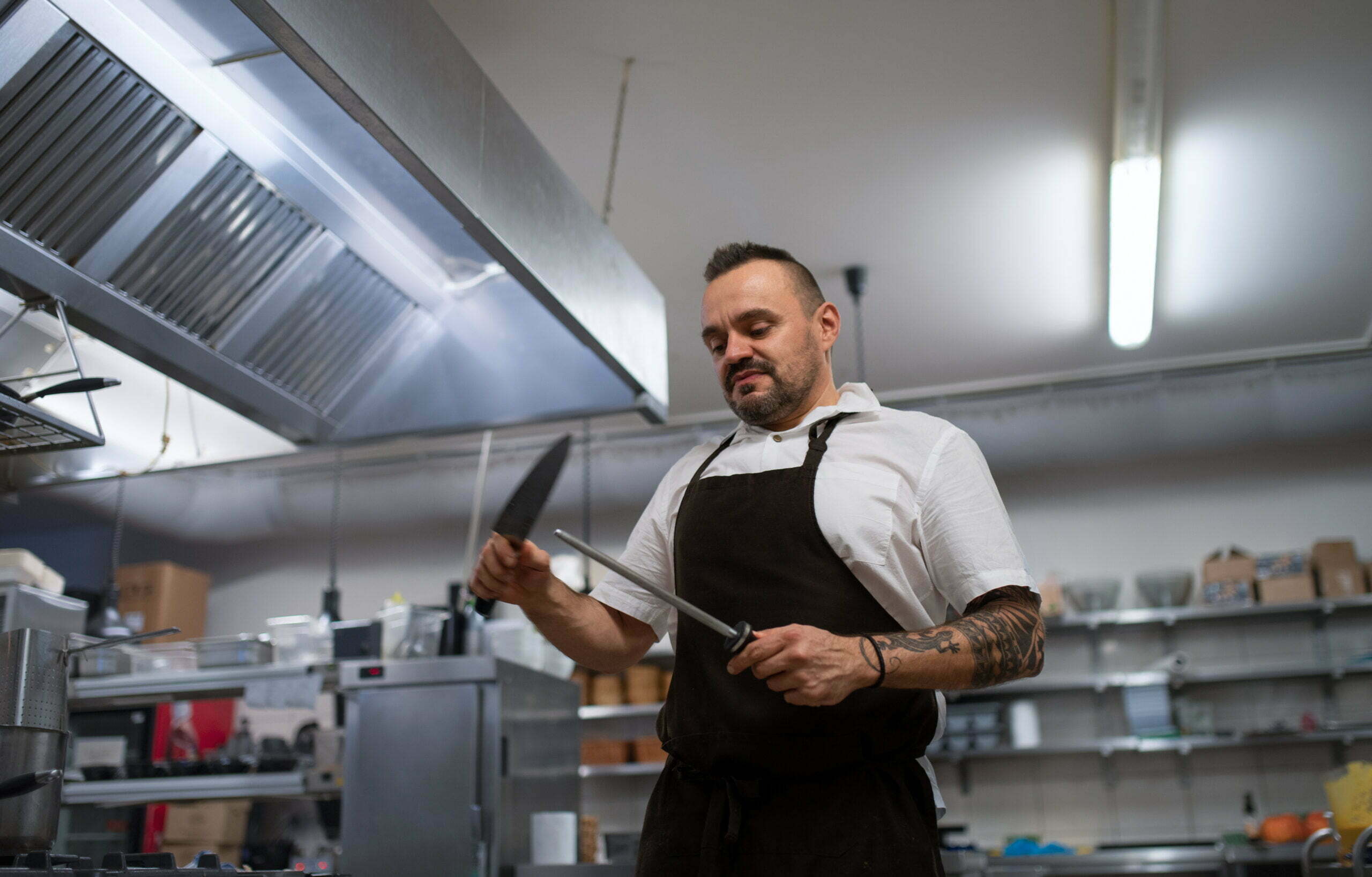
Buying the perfect knife is a real challenge – especially for beginner cooks. The wide range of solutions available on the market often causes dilemmas even for more experienced masters of cooking. In such a situation, it is worth reaching for a universal model, such as a chef’s knife or a Santoku. What is the difference between them, what is their use, and which version is better to choose?
Chef’s Knife – The Most Popular Choice of Chefs
A chef’s knife is a timeless tool, useful when preparing a variety of dishes. It is distinguished by a long blade and a slightly curved edge, and its size is most often within the range of 18-24 cm. The grind is usually a full flat grind, but partially flat or concave versions are also available for sale. The shape of a chef’s knife allows for easy and precise cutting with a rocking motion – thanks to this, it works perfectly when cutting larger products. It is highly durable, and the optimally designed handle makes it also exceptionally comfortable for daily use.
Santoku Knife – The Most Important Tool in Japanese Cuisine
The second popular type of universal knife is the Santoku. It is a Japanese tool, whose name means “three uses.” Such a model can easily handle cutting meat, vegetables, and fish. Its characteristic feature is the shape of the blade – a straight cutting edge and a slightly bent spine. Such a structure enables precise cutting in a vertical and horizontal motion. The length of a Santoku knife is most often from 14 to 18 cm. Traditionally, it was sharpened on one side, but today you can find models with double-beveled blades for sale.
Chef’s Knife vs. Santoku Knife – Differences in Construction
Although a chef’s knife and a Santoku have a similar use, their construction is quite different. The first of the mentioned models is usually longer – which allows for easier processing of large food products. A Santoku knife, on the other hand, will be suitable for cutting smaller vegetables or fish. Both tools differ in the shape of the blade: in a chef’s knife, it is curved, while in a Santoku – it is straight. It is also worth mentioning the weight of both models here. A chef’s knife is most often heavier than a Santoku. This is due to its larger size and the amount of material used in production.
Santoku Knife and Chef’s Knife – Application
Are you wondering about choosing a knife? First of all, take into account what food products you intend to cut with it. The Santoku will be the ideal tool for processing smaller portions of meat, fish, and vegetables. Lighter and smaller than a chef’s knife – thanks to its compact dimensions, it is more maneuverable, enabling precise cuts in harder-to-reach places. You can also reach for it when preparing oriental dishes, such as sushi or sashimi.
If you cut large amounts of meat or vegetables on a daily basis, a chef’s knife will be useful. By using it, you can crush nuts, slice bread, and mash products to release their aroma. Its larger blade allows for easy cutting of portions from large pieces of meat or fish. It will also be helpful when transferring sliced products to a pot or frying pan – thus shortening the time of meal preparation.

Chef’s Knife or Santoku Knife? What to Pay Attention to?
When choosing a new knife, it is always worth adapting it to your own preferences. Some people prefer to use a large tool, while others prefer smaller and more precise models.
Both a chef’s knife and a Santoku are proposals with a relatively universal purpose. With their help, you can slice meat and fish, and mince and chop vegetables or fruits. Pay attention to the material from which the handle is made. It is best to choose a model with a wooden handle, which is characterized by an aesthetic appearance, is comfortable to hold, and is distinguished by excellent durability.
For many people, the purchase price is also an important criterion. You can find chef’s knives or Santoku for sale up to PLN 300. However, most models exceed this budget, which is related to the highest quality of workmanship and the class of materials used. Although their purchase cost is higher, chef’s knives and Santoku are much harder and sharper than European models. Thanks to this, they will serve their users for a longer time, working perfectly as an element of kitchen equipment or an exclusive gift.
Which Knife Is Worth Buying – Chef’s or Santoku?
As the name suggests, the chef’s knife is the most common choice of professionals. Such a model will work in every situation where its larger size is an advantage. It is characterized by multifunctionality and ease of use, thanks to which daily work becomes a real pleasure. Thanks to being made of the highest class components, the chef’s knife is exceptionally durable and sharp. What’s more, its sharpening is also extremely simple – allowing you to enjoy the benefits of this tool for a long time.
The Santoku knife, on the other hand, is a combination of a Japanese chef’s knife (called Gyuto) and a small cleaver. You can use it not only when preparing Asian dishes, but also European ones, which require cutting vegetables, meat, or fish into small pieces. Due to the lower carbon content – and consequently a thinner and lighter construction – the Santoku knife will guarantee maximum work comfort. It is also worth mentioning a special hardening process, thanks to which it maintains its sharpness for an exceptionally long time.
A chef’s knife or a Santoku knife are tools that should not be missing in any professional kitchen. Due to the precision of their cuts and ease of use, they are also eagerly chosen by amateur cooks. They differ in blade shape, dimensions, weight, but also application. If you need a knife for processing smaller products – choose the Santoku model. If, on the other hand, you want to quickly cut large portions of meat or vegetables – you can do this by using a chef’s knife.


