

Japanese kitchen knives have long been gaining recognition among professional chefs and cooking enthusiasts in Poland and all over the world. Their incredible sharpness and excellent quality of craftsmanship make them often perceived as masterpieces in the world of kitchen knives. However, the most important aspect that proves the superiority of Japanese kitchen knives over their European counterparts is the quality of the steel used and the heat treatment method by master blacksmiths.
The purchase of a Japanese knife, however, is often associated with high prices, which can be a barrier for many people. Fortunately, there is a quite wide selection of Japanese kitchen knives that are available at a more affordable price, not exceeding 300 PLN.
We quite often get an inquiry from our clients “what good Japanese knives do you recommend up to the amount of…”. In this article, we want to take a look at this category of kitchen knives and present some interesting options that are available in the price range up to 300 PLN. This is a quite economical category, but we managed to present some really interesting knives that are ideal for a home kitchen. We tried to propose the most popular types of knives such as Gyuto (chef’s knife), Nakiri (vegetable knife) or small utility knives, so that everyone can find something for themselves. It is also possible to put together a nice set based on our recommendations.
If you are interested in Japanese kitchen knives and would like to find out which models we recommend for a price up to 300 PLN, then be sure to read this post and check out our recommendations. We have prepared a few knife suggestions for you that have been tested by us and our clients, so you can enjoy Japanese quality in your kitchen without ruining your home budget.
Kanetsugu Miyabi Issin Chef’s Knife 180 mm

Our first suggestion is a bestseller in its price category. The Kanetsugu Miyabi Issin Gyuto, with a blade length of 180 mm, is the Japanese equivalent of a chef’s knife, ideal for most kitchen tasks.
The knives from the Kanetsugu Miyabi Issin series are made of high-carbon stainless steel in a three-layer construction, known as SAN-MAI. This production method involves forging the knife’s core from hard high-carbon steel “AUS-8“, and then covering it with soft SUS-410 steel. Thanks to this, the hard AUS-8 core is shielded by the outer layers of soft SUS-410 steel, which additionally gives the knife flexibility.
Kanetsugu Miyabi Issin Nakiri Knife 165 mm
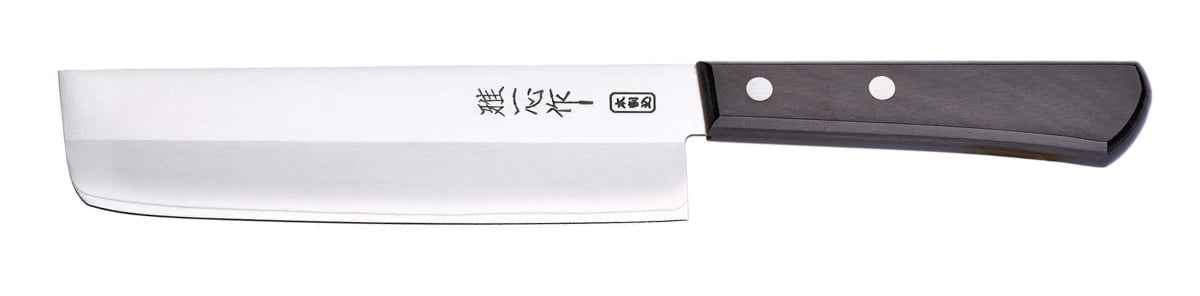
Our next suggestion is a Nakiri Knife, which resembles a cleaver in appearance, but unlike it, it has a thin blade, ideal for cutting and chopping vegetables. If you love chopping, this knife is for you.
The Kanetsugu Miyabi Issin series is a collection of elegant knives made of high-carbon stainless steel AUS-8 in a three-layer SAN-MAI construction. During the hardening process, Miyabi Issin knives achieve a hardness of 57-58 HRC, which means they will hold their sharpness longer than most popular European knives.
The handle with an ergonomic shape is made of brown rosewood and reinforced with two rivets. The wood used for the handle is properly impregnated to be resistant to water and moisture.
Masahiro MSC Brown Chef’s Knife 180 mm

Our third suggestion is a chef’s knife from the renowned MSC series, with a blade length of 180 mm. It is a basic knife that will work for most kitchen tasks. The blade of this knife is made in a special process – it is forged from a steel called MBS-26 (it is a high-carbon steel), and as a result of the hardening process (developed by the company’s owners, the Hattori family), it gains an impressive hardness of 58-59 HRC.
Kanetsugu Pro-M Utility Knife 150 mm

Another suggestion for a knife at a price up to 300 PLN is the universal Kanetsugu Pro-M knife, with a blade length of 150 mm. It is perfect for precise work in the kitchen with smaller products. The kitchen knives from the Kanetsugu Pro-M series are very popular among customers. During the hardening process, the knives are subjected to a heat treatment, known as “sub-zero treatment,” in which the blades are rapidly cooled to a temperature of -70 °C. Thanks to this, they gain an impressive hardness of 59+/-1 HRC. What distinguishes these knives is their extraordinary cutting properties, which are the result of proper hardening and the convex grind, known as “hamaguri ba.”
Kanetsugu Miyabi Issin Chef’s Knife 210 mm

This chef’s knife is distinguished by a slightly larger size compared to our previous suggestions, its blade has a length of 21 cm. During the hardening process, Miyabi Issin knives achieve a hardness of 57-58 HRC, which means they hold their sharpness for a long time and are easy to re-sharpen. The handle is made of natural, brown rosewood and reinforced with two rivets. The wood used for the handle has been properly impregnated to be resistant to moisture and changing temperatures.
Seki Kanetsugu is one of the oldest companies producing kitchen knives in the city of Seki, in Japan. The company was founded over 100 years ago by Matsujiro Kawamura, a descendant of the famous samurai sword maker, Kanetsugu, who was active in the years 1336-1392.
Masutani Tsuchime Santoku 170mm VG-1

A knife that slightly exceeds the 300 PLN budget, but we believe it is absolutely worth its price, is the Masutani Santoku with a blade length of 170 mm. It is a very handy and useful knife for various culinary tasks, being the Japanese equivalent of a classic chef’s knife.
Japanese Masutani knives are handmade in the Fukui prefecture, in Echizen. They are even comparable to much more expensive models. As for their core, it is made of high-carbon stainless steel VG-1, while the outer layers are hammered steel, giving them an exceptionally attractive appearance. The hardness of the blades is 61 +/- 1 HRC, which means the blade remains exceptionally sharp for a very long time.
We also encourage you to read our ranking of Japanese kitchen knives for 2023.


